
Smarter Moisture Probe Placement Using Soil and Slope Mapping
28 October 2026
Getting the most from soil moisture probes starts with putting them in the right location.
Building on our recent work using electromagnetic (EM) mapping to guide moisture probe placement in cotton fields, OptiSoil has been combining DualEM soil mapping with elevation data collected by seeding tractors to identify more representative locations for irrigation monitoring.
It's a simple application of precision agriculture that can help growers make better irrigation decisions without changing their existing irrigation systems or management practices.
Understanding the soil beneath the field
DualEM surveys measure apparent soil electrical conductivity, which is influenced by factors including clay content, salinity and soil moisture.
In this case, the DualEM survey was completed following a long fallow, when soil moisture differences were expected to have less influence on the readings. This allows the mapping to provide a clearer indication of underlying differences in soil properties, particularly clay content and salinity.
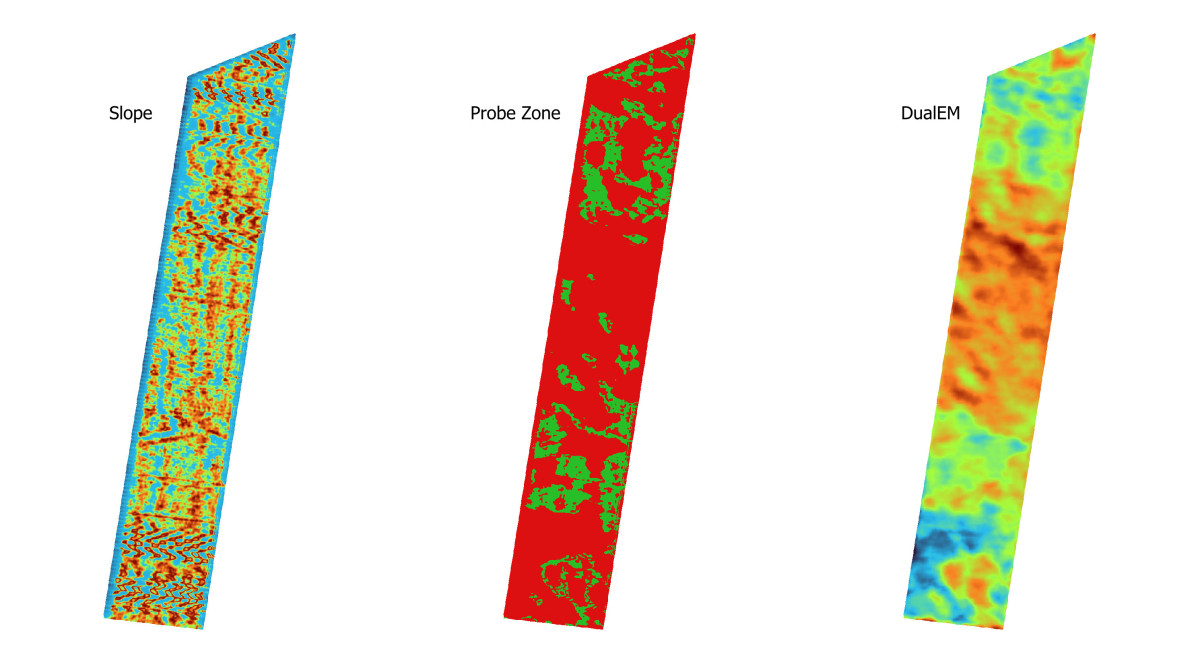
The resulting map helps identify the main soil zones across the field, including areas with potentially heavier and lighter soils.
Adding slope data to the picture
Soil type is only part of the equation. The position of a probe within the landscape can also influence how quickly the soil wets up and dries out.
Using elevation data collected by the seeding tractor, OptiSoil calculated the slope across the field.
This helps identify areas where water may accumulate or drainage may be slower, as well as steeper areas where surface runoff is more likely.
By combining the DualEM mapping with the slope information, we can identify locations with soil properties close to the field's typical conditions, while avoiding unusual slope positions.
The result is a zoned probe placement map that provides a practical guide to choosing a representative monitoring location.
Why the wrong probe location can cost yield
A soil moisture probe only measures conditions at its installation point. If that location isn't representative of the wider field, irrigation decisions based on its readings can be misleading.
For example, a probe installed in heavier soil or a poorly drained area may show that moisture is still readily available, even when lighter soils elsewhere in the field are drying out. This could delay irrigation and leave parts of the crop short of water, reducing yield potential.
The opposite can happen when a probe is installed in lighter soil or on a steeper slope.
These areas may dry out more quickly, prompting more frequent irrigation than the majority of the field requires. This can increase the risk of waterlogging in heavier soils and lower-lying areas, potentially affecting crop performance and wasting water.
In both situations, the moisture probe may be working perfectly. The problem is simply where it was installed.
A simple precision agriculture improvement
One of the benefits of this approach is its simplicity.
By combining existing tractor elevation data with DualEM mapping, growers can make a more informed decision about where to install their moisture probes.
There's no need to introduce a new irrigation system or change the way the field is managed.
Instead, the aim is to improve the quality of information being used to make irrigation decisions.
For fields with considerable variation in soil type or drainage, additional probes or separate monitoring zones may still be needed. However, where a single probe is intended to guide irrigation across a field, choosing a representative location is an important first step.
Make your moisture probes work harder
Good irrigation scheduling depends on good information, and that starts with understanding what your moisture probe is actually representing.
OptiSoil combines DualEM mapping, field topography and soil science to help growers identify suitable probe locations and make more informed irrigation decisions.
Contact OptiSoil to discuss how soil and slope mapping can help improve moisture probe placement on your farm.